

Can artificial intelligence improve the accuracy of predicting catastrophic hurricanes?
- Last update: 44 minutes ago
- 3 min read
- 699 Views
- BUSINESS
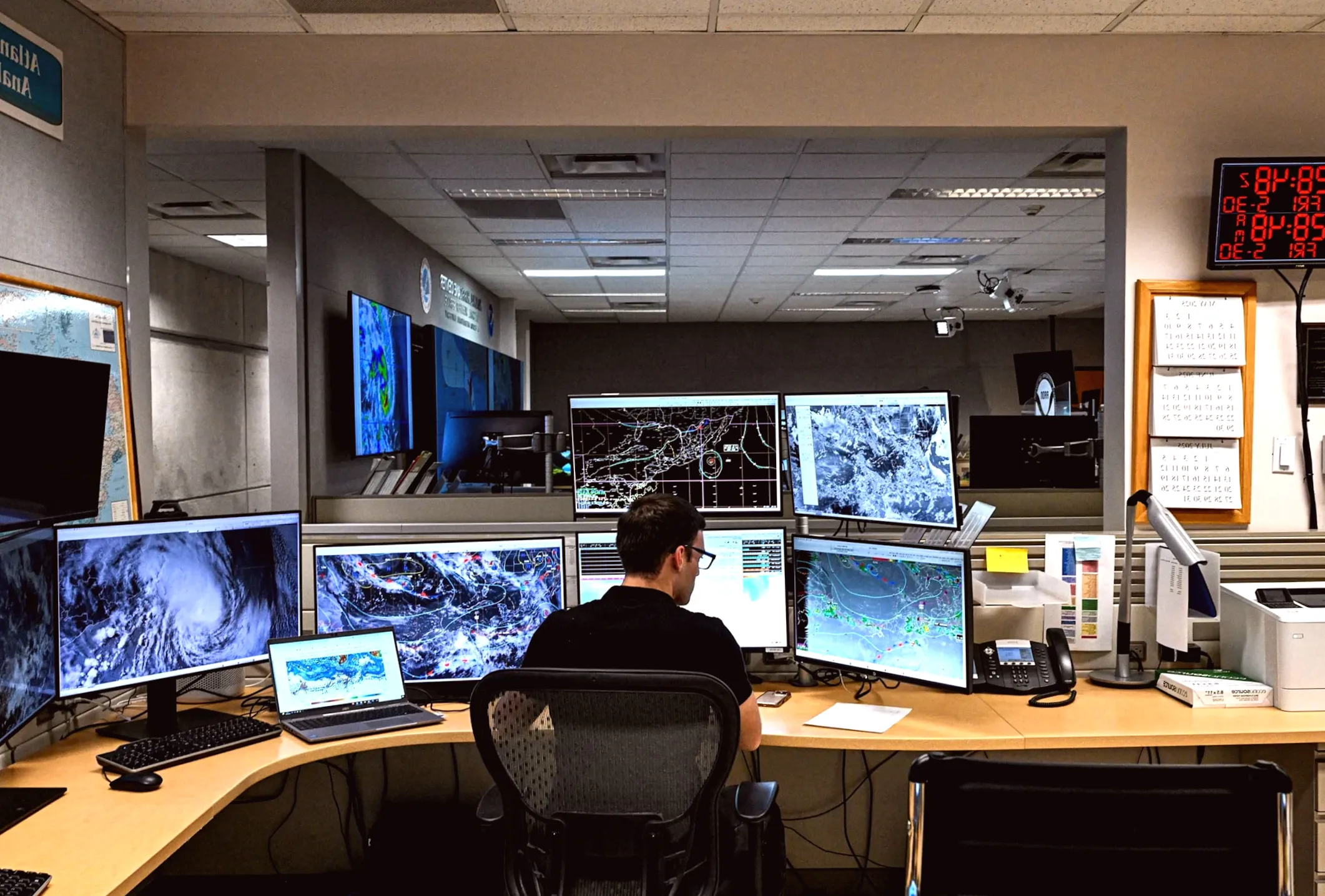
AI-enhanced weather models were tested during the 2025 hurricane season, with experts suggesting that such models may become essential for future hurricane predictions. At the start of the 2025 Atlantic hurricane season, the National Hurricane Center (NHC) announced a collaboration with Google DeepMind, the AI research lab, to integrate its latest weather model into the NHC's tropical cyclone forecasting operations.
"This partnership between NOAA and Google will enable the National Hurricane Center to swiftly assess emerging forecasting technologies for tropical cyclones," stated Michael Brennan, the NHC director, in a NOAA press release.
As noted by NOAA, once DeepMind's model was incorporated into forecasters' existing toolkit, it outperformed traditional weather models in certain situations. One of the most notable successes was during the prediction of Hurricane Melissa. DeepMind's model, along with its European counterpart, gave NHC forecasters strong confidence that Hurricane Melissa would rapidly intensify into a major Category 5 storm before making landfall in Jamaica.
"I was genuinely impressed with DeepMind's ability to predict rapid intensification, a common challenge for many models," said Matt Lanza, managing editor of The Eyewall blog. "The models insights during Melissa were crucial in raising awareness of the high-end risks," he added.
According to NOAA, DeepMind's AI model was the most accurate for both storm track and intensity, with the only forecast outperforming it being the official NHC predictions.
James Franklin, a former NHC branch chief, discussed the results on social media, calling it a "remarkable year" for the Google DeepMind model. A representative from DeepMind cautioned, however, that the model's performance shouldn't be judged based on just one storm.
How AI Models Work
Traditional weather forecasting models, such as the European and American Global Forecast systems, rely on complex simulations based on atmospheric and physics equations. These models require substantial computing power and time to generate forecasts.
On the other hand, AI models like DeepMinds are faster and require less computational power. They learn from historical weather data, identifying patterns and relationships from previous storms, which helps them generate predictions in just seconds.
"AI models use data from over 40 years of weather patterns, analyzing how the atmosphere behaves at six-hour intervals to 'learn' its evolution over time," explained Ryan Torn, a researcher at the University of Albany specializing in weather modeling. "Once the AI model understands the atmosphere, it can predict future conditions using current data." Torn added.
DeepMind's AI can generate hundreds of potential weather scenarios from a single starting point within minutes, whereas traditional models require hours to perform the same task.
Despite the benefits demonstrated during the 2025 hurricane season, experts emphasize the need for further research before AI-driven models dominate hurricane forecasting.
Lanza noted that while DeepMinds model showed promise, it still needs to prove its effectiveness in predicting Gulf storms, as the 2025 season was unusually calm. "AI models may not fully capture extreme events, especially those outside the expected range of climate patterns," Lanza said. "In such cases, traditional physics-based models may remain indispensable."
Torn further emphasized the role of traditional models, which handle sudden weather changes and data gaps better than AI systems, which tend to smooth out inconsistencies. "AI models might spread out differences in weather patterns over large areas, which is not physically accurate and could impact predictions," Torn explained. "Traditional physics-based models generally perform better in these scenarios."
Although AI models do not calculate complex atmospheric equations like traditional models, DeepMind's representative noted that these AI systems complement existing models. They use the traditional models for training and initial conditions, blending speed and precision to enhance predictions.
Author: Benjamin Carter
Share
Expert explains why the US avoided a hurricane for the first time in ten years: 'The key factor…'
4 hours ago 2 min read US

Advancements in flood risk understanding by ORNL supercomputer tool
2 days ago 3 min read BUSINESS

AI model provided the most accurate hurricane forecasts in 2025
2 days ago 3 min read BUSINESS

The 2025 hurricane season has ended. It was more severe than anticipated.
5 days ago 3 min read WORLD