

CNN's John Berman Denies Own Question After Senator Objects
- Last update: 2 hours ago
- 3 min read
- 771 Views
- POLITICS
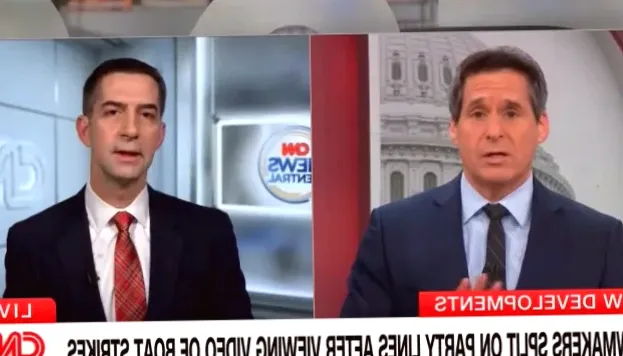
John Berman, visibly frustrated, answered his own question regarding U.S. airstrikes on alleged drug-smuggling vessels during a tense exchange with Senator Tom Cotton (R-AR). The focus of the debate was on the Trump administration's ongoing aerial assaults targeting boats believed to be carrying illicit drugs in the Caribbean and Pacific regions.
Berman inquired about a specific incident in September, where the U.S. military launched a double-strike on a vessel near Trinidad. The U.S. initially dismissed the second strike as "fake news," but later confirmed that it had targeted two survivors who were clinging to the wreckage of the boat, killing them both. Legal experts have argued that this strike violated both U.S. and international law, particularly when considering the broader campaign of maritime bombings.
While hosting CNN's *The Lead* on Friday, Berman questioned Senator Cotton: Would it be legal for police in Arkansas to kill suspected drug dealers on a boat in an overturned lake?
Instead of addressing the legalities of the second strike, Cotton pivoted to defend the broader U.S. military campaign, suggesting that the real issue for Democrats was not the second strike, but the legitimacy of the entire operation. Cotton argued, "The problem they have is not with the second strike. Its with the first strike and every subsequent attack on these boats. They believe the entire operation is unfounded. I disagree with them. If these boats were carrying bombs or missiles aimed at the United States, no one would dispute our right to intercept them.
Berman returned to his original query, pressing for a direct answer: "Would it be legal for police in Arkansas to kill suspected drug dealers in an overturned boat in a lake?"
Cotton replied by rejecting the premise of the question, emphasizing the difference between domestic law enforcement and foreign threats. "Criminals in Arkansas are not foreign nationals connected to a designated terrorist organization," he stated.
Berman, undeterred, responded: "The answer is no, it would not be legal. But let me follow up: If they were terrorists, when did Congress authorize the use of force to target them?"
Cotton responded, defending the president's constitutional authority as commander-in-chief, asserting that U.S. law permits the president to take action against foreign terrorist organizations. He argued that Congress had passed laws to designate such organizations, thereby granting the president the power to target them.
Berman countered by referring to past military actions, asking when Congress had authorized military force to attack suspected drug traffickers, drawing parallels to the legal framework used in targeting terrorists.
Ultimately, the exchange highlighted the ongoing debate over the legality of the U.S. government's approach to countering drug trafficking through military means, and raised critical questions about the intersection of domestic law, international law, and military authority.
Author: Harper Simmons
Share

UPDATED: Alleged Drug Boat Bombed Twice by U.S. Wasn't Actually En Route to the United States
2 hours ago 2 min read ENTERTAINMENT

Tom Cotton Supports U.S. Strikes On Alleged Drug Boat as Justifiable
15 hours ago 2 min read POLITICS

Tom Cotton justifies the need to kill survivors of double-tap strike for attempting to flip boat
16 hours ago 2 min read WORLD

US military attacks second suspected drug boat while investigation into initial strike commences
19 hours ago 2 min read WORLD

Pentagon Pete's Attempt to Shift Blame Fails
21 hours ago 3 min read POLITICS
Facts About Admiral Frank Bradley - Facing Criticism for Second Attack on Survivors
1 days ago 2 min read POLITICS

Admiral viewed alleged drug boat strike survivors as acceptable targets, defense official claims
1 days ago 2 min read WORLD
Admiral Mitch Bradley to update Senate committee on boat collisions
1 days ago 2 min read POLITICS
Trump supports the release of a second video of a boat collision.
1 days ago 2 min read WORLD

Trump officials claim second strike targeted drug boat, not crew
2 days ago 3 min read POLITICS