

Capturing the Remarkable Shot: The Fall of Icarus
- Last update: 34 minutes ago
- 4 min read
- 913 Views
- WORLD
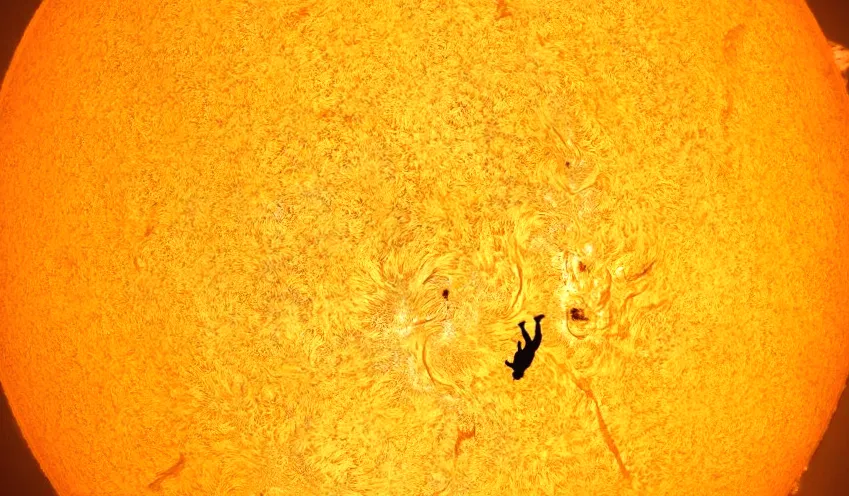
On a vast dry lakebed in Arizona, known as Wilcox Playa, astrophotographer Andrew McCarthy stood steady as trains rumbled nearby, threatening to blur a shot that had been months in the making. A crowd gathered, watching McCarthy as he attempted and failed six times to capture the perfect image with a plane overhead. His friend, Gabriel C. Brown, was in the plane, perched on the edge of his seat, awaiting the signal to jump.
Brown had originally planned to make several attempts, assuming there would be time to land, repack, and try again if needed. But the pilot informed them that the plane was only available that morning, leaving them with a single chance. With the sun climbing, McCarthy and Brown had no more opportunities. Brown, aware of the gravity of the moment, told McCarthy, "Dont tell me to jump unless you are absolutely sure." With the plane in position, McCarthy counted down, "Three, two, one, go!" As Brown descended, he asked through the headset, "Did you get it?" Finally, McCarthy had captured the imagea lone silhouette against the suns textured face. It was perfect, McCarthy recalled. We knew we had something special.
A Journey of Wonder
As a child, McCarthy's room was decorated with glow-in-the-dark planets, and he would often look at Saturn and Jupiter through his backyard telescope with his father. Even then, he was fascinated by space, though he didnt fully understand what he was observing. Years later, as an adult with a "boring desk job" and some spare cash, McCarthy bought a new telescope. He gazed at the sky and felt an overwhelming sense of being both small and significant"a part of the universe that is self-aware enough to appreciate its beauty." This sense of wonder inspired him to capture the beauty of the universe and share it with others. Starting with blurry photos taken through his telescope with an old iPhone, he became determined to improve his craft.
The Leap of Faith
Over the next six years, McCarthy's projects became increasingly complex. After photographing a rocket crossing the sun, he sought a new challenge. The breakthrough came during a skydiving session, when McCarthy and Brown, an experienced skydiver, came up with the idea of having someone jump out of a plane in front of the sun. Though the concept seemed nearly impossible, McCarthy was determined to make it work. To get the perfect shot, the sun had to be low, the jumper high, and McCarthys position had to be flawless. The plane had to be in the right place between the sun and McCarthys camera, with the suns rays guiding the pilot into alignment.
'The Fall of Icarus'
McCarthy titled the shot "The Fall of Icarus" to reflect the insignificance of humanity in the face of natures immense power, rather than the tragedy of the myth itself. He explained that the sun is a force beyond our controlit continues to burn no matter what we do. Using advanced techniques like image stacking, McCarthy combined thousands of frames to enhance the details of the sun and reduce noise, bringing the celestial details into sharp focus.
The myth of Icarus tells the story of a young man who flew too close to the sun with wings made of feathers and wax, ignoring his fathers warning. As he rose higher, the wax melted, and he fell into the sea. The story represents both human ambition and the limits of human power. For Brown, the photo symbolizes human achievement but also human hubris. However, McCarthy is more interested in how viewers interpret the image. "Id rather see what people think when they look at it, he said.
Proving Its Authenticity
When the image was published, many people questioned its authenticity due to the increasing use of AI and advanced editing tools in photography. Fellow astrophotographer Connor Matherne, who had collaborated with McCarthy on previous projects, immediately recognized the achievement. Hes done it again. Another spectacular photo, pushing the envelope, Matherne remarked. McCarthys work has set new standards for astrophotographers, inspiring others to take on seemingly impossible challenges. However, McCarthy faced skepticism from online audiences, with many dismissing the image as fake. To address this, he filmed behind-the-scenes footage and shared details of his image-stacking process to prove the shot was genuine.
Despite the challenges, McCarthy and Matherne take joy in capturing real moments that reveal the hidden beauty of the universe. It can be frustrating to spend 40 hours on a photo only to have people dismiss it as fake, Matherne said, but for both photographers, the thrill is in sharing those authentic, awe-inspiring moments with the world.
Author: Caleb Jennings