
The First Close Examination of a Tsunami from Space Uncovers Surprising Characteristic
- Last update: 3 days ago
- 2 min read
- 13 Views
- WORLD
A recent satellite observation has recorded a tsunami with an accuracy never achieved before, offering new insights that could refine tsunami models and improve early warning systems. Launched in 2022 through a collaboration between NASA and the French space agency CNES, the Surface Water and Ocean Topography (SWOT) satellite was built to monitor global water movements by detecting changes in surface height.
While SWOT initially focused on measuring small ocean currents, it unexpectedly captured a significant event. On July 29, 2025, an 8.8 magnitude earthquake struck the Kuril-Kamchatka subduction zone near Russia's southeastern coast, generating a powerful tsunami across the Pacific Ocean just as the satellite passed overhead.
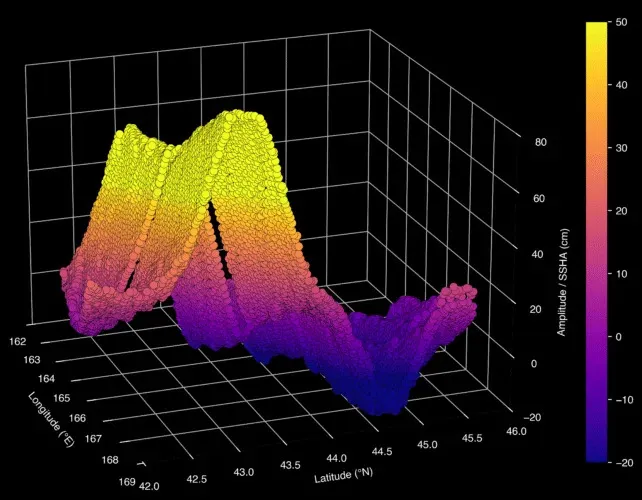
By combining SWOT's observations with data from three nearby buoys in the Deep-ocean Assessment and Reporting of Tsunamis (DART) network, scientists were able to map a tsunami propagation pattern that was more intricate than anticipated. Notably, the findings challenge previous assumptions: large tsunamis were thought to travel largely as single, cohesive waves, but the new data reveal that the wave fragmented into a prominent leading wave followed by smaller waves trailing behind.
The leading wave, depicted in red in the data, reached heights of over 45 centimeters (1.5 feet). The epicenter of the earthquake is marked with a star in the satellite imagery.
"I consider SWOT's data like putting on a new pair of glasses," explained Angel Ruiz-Angulo, the study's lead author and physical oceanographer at the University of Iceland. "Previously, DART buoys only allowed us to observe tsunamis at isolated points across the ocean. Other satellites offered just a narrow view across the wave. SWOT, however, provides a swath up to 120 kilometers wide, capturing high-resolution details of the sea surface."
Thanks to its timing, SWOT could become a critical tool for real-time tsunami detection, potentially providing earlier warnings for coastal regions at risk. The study was published in The Seismic Record.
Author: Sophia Brooks
Share

Venezuela's Nicolas Maduro dances amid escalating tensions with US
2 minutes ago 2 min read WORLD
Controversial video from inside cruise ship sparks online debate: 'This is awful'
2 minutes ago 2 min read WORLD

Britain abolishes jury trials for sentences under 3 years
7 minutes ago 2 min read WORLD

Unregistered children's care homes cost labeled a 'national scandal' by Ofsted
10 minutes ago 3 min read WORLD
SpaceX prepares for Falcon 9 rocket launch on Tuesday from Florida's Space Coast
10 minutes ago 1 min read WORLD

Audi Plunges from Apartment Car Stacker in Australia
19 minutes ago 1 min read WORLD

Hong Kong holds legislative election following tragic fire
19 minutes ago 3 min read WORLD

Tragedy strikes in Goa, India as 23 lose their lives in nightclub fire
20 minutes ago 2 min read WORLD
Ex-educator sentenced for sexual crimes against children
23 minutes ago 1 min read WORLD
Woman warns against harmful backyard habit that can harm animals: 'It's a serious problem'
23 minutes ago 2 min read WORLD