
The Navy's New Medium Landing Ship Revealed
- Last update: 2 hours ago
- 6 min read
- 678 Views
- POLITICS
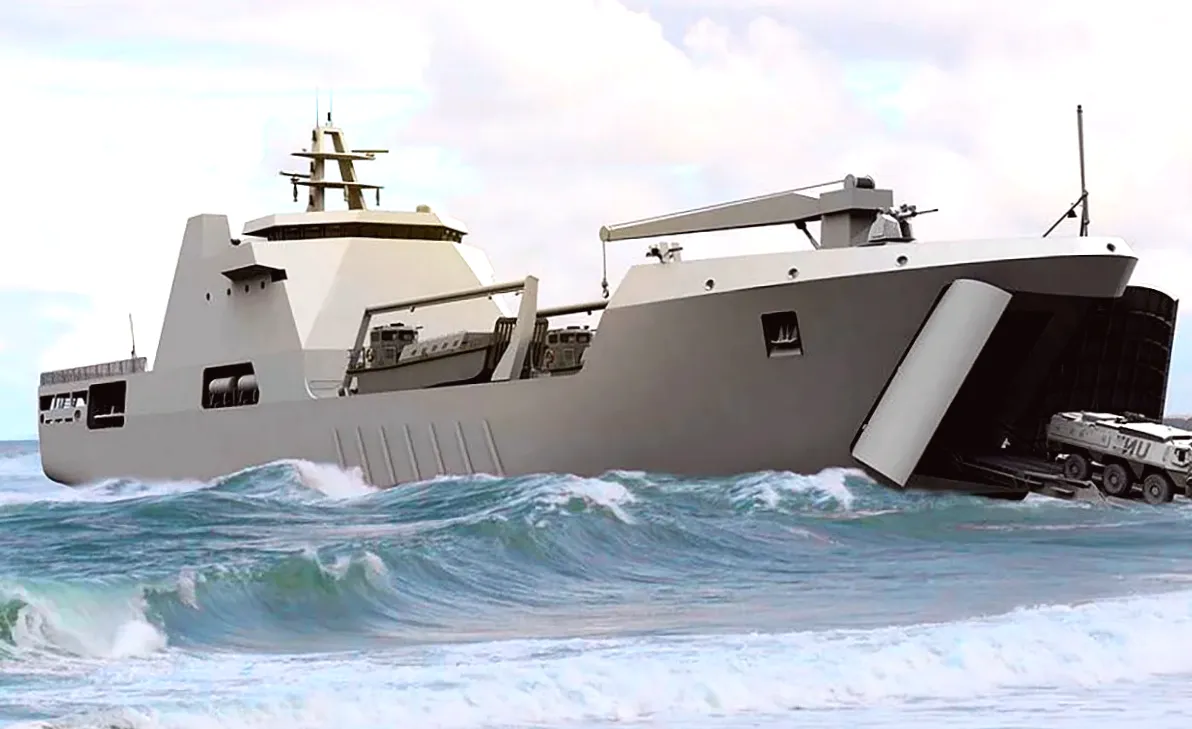
The U.S. Navy has selected the LST-100, designed by the Dutch shipbuilder Damen, to serve as the foundation for a new class of Medium Landing Ships (LSMs). The objective is to receive the first of these vessels by the end of this decade, aiming to sidestep the setbacks that have become a troubling pattern in recent U.S. naval shipbuilding projects. The planned procurement of 35 LSMs, a project that has faced delays over the years, is viewed as crucial for supporting the evolving operational concepts of the U.S. Marine Corps, particularly its expeditionary and distributed operations. The Navy made the announcement today via a social media video, featuring comments from key military leaders including Secretary of the Navy John Phelan, Chief of Naval Operations Admiral Daryl Caudle, and Marine Corps Commandant General Eric Smith.
Naval Sea Systems Command (NAVSEA) has separately confirmed its expectation to begin construction of the first LSM based on the LST-100 design in 2026, with delivery scheduled for 2029. These vessels will primarily be tasked with transporting small Marine units, especially between distant islands, without needing access to established portsideal for potential conflicts in the Pacific region.
"As I announced last week, we are fundamentally reshaping how the Navy builds and fields its fleet," stated Secretary Phelan in the video. "Today, Im taking the second major step in that effort: selecting the design for our Medium Landing Ship. This operationally driven, fiscally responsible decision ensures that we can deliver enhanced capabilities to the fleet on a reasonable timeline." Phelan went on to explain that the LSM design selection was approved last month with the input of the Marine Corps Commandant and Chief of Naval Operations, noting that the LST-100 is a 4,000-ton vessel with a range exceeding 3,400 nautical miles. This design strikes a balance between capability, affordability, and speed.
The baseline LST-100 is approximately 328 feet (100 meters) in length, 52.5 feet (16 meters) in width, and can achieve a maximum speed of 14 knots. The ship is equipped with a bow that allows for beach landings and unloading of vehicles, troops, and other cargo via clamshell doors. Additionally, a loading ramp at the stern provides more versatility. With a standard crew of just 18, the ship can deploy smaller landing craft and maneuver large payloads with the aid of a large crane located at the bow. Furthermore, it includes a flight deck at the stern that can accommodate an NH-90 or a similar-sized helicopter. The vessel has the capacity to transport up to 234 personnel and 11,000 square feet (1,020 square meters) of roll-on/roll-off cargo.
General Smith emphasized the importance of the LST-100s design in todays video: The LST-100s cargo, helicopter capacity, berthing, and crane make it an excellent fit for the Marine Corps requirement for at least 35 Medium Landing Ships to support naval expeditionary forces. These ships will provide increased agility and flexibility in austere environments without port facilities, enabling operational mobility within an adversarys Weapons Engagement Zone.
NAVSEA has confirmed that there are no significant modifications planned to the LST-100s baseline design. Damen will provide engineering services to integrate class-standard equipment and ensure compliance with U.S. regulations and the Buy American Act, ensuring long-term sustainability for the platform.
The Marine Corps views the LSM fleet as essential to its evolving operational concepts, focusing on the rapid deployment of small forces to distant areas, often within a larger island-hopping strategy in the Pacific. This approach is designed to disrupt enemy operations by creating unpredictable, dispersed forces.
The Navy and Marine Corps have been debating the design and specifications for this program for several years. In December 2024, the Navy canceled a request for proposals due to "affordability concerns," but by January 2025, it had begun considering commercially available designs to move the project forward. Admiral Caudle explained that the Navy reconsidered the program by evaluating existing, proven designs that met Marine Corps requirements, ultimately deciding on the LST-100.
The LST-100 design has already seen success in other navies. The Nigerian Navy currently operates an LST-100 and has a second vessel on order. Additionally, the Australian government has selected the same design to meet its Landing Craft Heavy requirements, with plans to build the ships domestically in Australia by Austal.
In his announcement, Secretary Phelan noted that the Navy intends to award a construction manager to oversee the LSM program, ensuring competition among multiple shipyards. In a step toward domestic production, NAVSEA has secured the rights to the LST-100s technical data, which will allow for the construction of LSMs and subcomponents in the United States, eliminating reliance on foreign vendors. This approach is seen as a way to minimize risks associated with cost overruns and delays, leveraging a tried-and-true, non-developmental design.
"This non-developmental, build-to-print strategy reduces both cost and technical risks," Phelan remarked. "By working with Congress, we are adopting commercial practices that will expedite the process and ensure that we deliver the capability the fleet needs." Admiral Caudle further elaborated on the Navy's commitment to incorporating commercial best practices into shipbuilding, ensuring the ships will be production-ready and able to meet operational requirements.
The Navy is targeting 2026 as the start of construction for the first LSM, with delivery expected by 2029. However, the timeline for the entire fleet of 35 vessels is still uncertain. In the meantime, the Navy and Marines have been acquiring interim ships and contracting with other vessels to support the distributed operational concepts that the LSMs are intended to enable.
The Navy also plans to build at least one LSM at Bollinger Shipyards, potentially using a design developed for Israel called the Israeli Logistics Support Vessel (ILSV), a variant of the General Frank S. Besson-class Logistics Support Vessel used by the U.S. Army.
The naming plan for the LSMs has not changed. The first ship in the class will be named USS McClung, honoring U.S. Naval Academy graduate and Public Affairs Officer Major Megan M.L. McClung, who was killed in action in Iraq.
As the Navy and Marine Corps continue to innovate in shipbuilding, they are focusing on lessons learned from past projects to improve efficiency, cost-effectiveness, and capability. The selection of the LST-100 design marks a critical step in achieving the Navy's vision for a new era in shipbuilding.
Author: Ethan Caldwell