
Thune prevents Johnson from advancing Georgia sanctions bill
- Last update: 46 minutes ago
- 3 min read
- 160 Views
- POLITICS
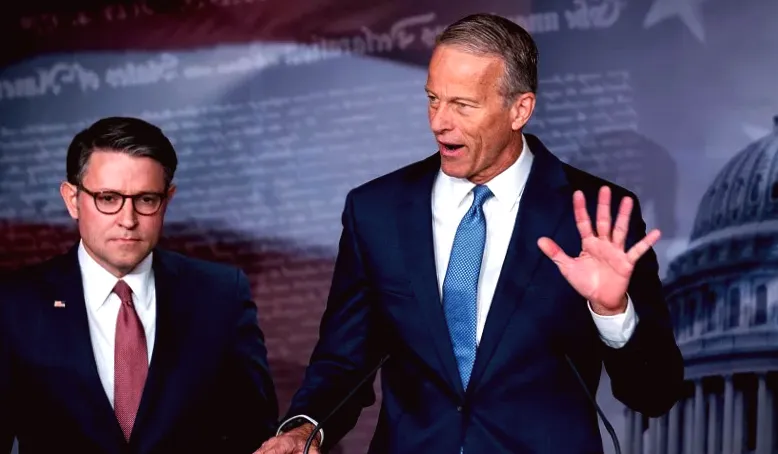
Senate Majority Leader John Thune (R-S.D.) declined a direct appeal from House Speaker Mike Johnson (R-La.) last month to move forward with a sanctions bill aimed at Georgian officials aligned with Russia and opposing democratic reforms, according to congressional aides.
Johnson sought to attach the legislation, known as the Megobari Act, to the National Defense Authorization Act (NDAA), the annual defense spending bill required by law. The measure has significant support across both chambers and would compel the president to sanction individuals threatening Georgias security and political stability.
Thunes refusal underscores growing tensions between him and Johnson. This marks the second instance in three months that Thune blocked bipartisan attempts to include the Megobari Act in the NDAA.
Johnsons intervention came late in the NDAA process and surprised many observers. Speaker Johnsons push appeared unexpectedly, said one congressional aide. After Thune blocked it in September, we assumed the bill was stalled. Despite last-minute efforts to include it at the Speakers request, Thunes opposition remained firm.
The initiative began on November 21, when Johnsons office mobilized staff to rally support from other Republicans and Democrats to add the bill to a nearly completed NDAA. Nevertheless, Thune maintained his opposition. He just said flat no, an aide noted.
Previously, Thune had also blocked the bill at the behest of Senator Markwayne Mullin (R-Okla.), disappointing bipartisan supporters and alarming pro-democracy activists. Mullin, who in 2020 criticized the Georgian Dream government for ties with American adversaries, later suggested using incentives rather than sanctions to influence Tbilisi, emphasizing cooperation with the Georgian leadership.
Mullins colleagues, however, do not view the ruling Georgian Dream party as cooperative. Since taking power in October 2024 under elections widely criticized as unfair, the party has carried out a campaign of repression, intimidation, and imprisonment against opponents and civil society groups. Reports indicate that Georgian security forces even deployed a World War I-era chemical weapon against protesters last year.
The Trump administration has maintained Biden-era sanctions on Georgian Dream officials but has not imposed new measures. Experts note that while the Megobari Act might not reverse Georgian Dreams course, it could still exert meaningful pressure by freezing assets, restricting visas, and signaling U.S. concern over Georgias authoritarian shift.
According to Elene Kintsurashvili of the German Marshall Fund, the act would increase the personal cost for Georgian officials and communicate that Washington views Georgias political trajectory as a strategic issue rather than a purely domestic matter.
Georgia is a key U.S. partner due to its strategic location in the Caucasus, historically democratic trajectory, and resistance to Russian aggression, though Russia still occupies South Ossetia and Abkhazia. The ruling partys growing ties with Moscow, China, and Iran have heightened concern among analysts and activists, who warn that without decisive U.S. and European action, Georgia may fall entirely under the influence of U.S. adversaries.
Pro-democracy voices argue that failure to pass the Megobari Act would embolden the Georgian Dream regime, weaken civil resistance, and intensify repression against protesters and dissenters.
Bipartisan lawmakers have pressed the Trump administration and publicly called for action. On November 5, Sen. Jeanne Shaheen (D-N.H.) and a group of legislators urged the State Department to protect U.S. and Georgian mission employees from false allegations of anti-government activities. Later, Shaheen and Sen. James E. Risch (R-Idaho) condemned Georgian Dreams authoritarian measures, marking a year since the party abandoned EU membership goals and escalated political repression.
They called on the Georgian government to restore democratic governance, protect political freedoms, and reverse recent authoritarian policies.
Author: Gavin Porter
Share

Supreme Court to discuss whether sidewalk preacher can continue First Amendment lawsuit
36 seconds ago 3 min read POLITICS

Hegseth justifies attacks on suspected cartel boats, states Trump has authority to use force 'as he deems necessary'
7 minutes ago 2 min read POLITICS

National Park Service eliminates free admission on MLK Day and Juneteenth, includes Trump's birthday in new policy
10 minutes ago 2 min read POLITICS

Richard Padzur to depart FDA after recent CDER leadership change
13 minutes ago 2 min read POLITICS

Report: Golf Partner Convinced Trump to Pardon Client During 18 Holes
13 minutes ago 2 min read POLITICS

Democrats increase examination of super PACs as part of analysis of 2024 election
21 minutes ago 3 min read POLITICS

Trump Continues to Discuss Fictional FIFA Award
24 minutes ago 2 min read POLITICS
Rand Paul accuses Pete Hegseth of being either 'incompetent' or 'lying' about Venezuela strike
45 minutes ago 3 min read POLITICS
Thune prevents Johnson from advancing Georgia sanctions bill
46 minutes ago 3 min read POLITICS

Pete Buttigieg backs Angie Craig in Minnesota Democrats' Senate primary
50 minutes ago 2 min read POLITICS