

Astronomer Explains Where Most Normal Matter in the Universe is Distributed, Not in Planets, Stars, or Galaxies
- Last update: 2 hours ago
- 5 min read
- 264 Views
- WORLD
When observing space through a telescope, youre likely to see countless galaxies, each housing large central black holes, billions of stars, and their orbiting planets. These immense celestial bodies create the impression that they must account for the majority of the universes matter. However, the Big Bang theory predicts that around 5% of the universes matter should be composed of atoms made from protons, neutrons, and electrons, and most of this matter is not located in stars or galaxies, which has baffled astronomers. So, where is it? The most probable location for this elusive matter is in the vast, dark spaces between galaxies.
Space, although often described as a vacuum, is far from empty. It contains scattered particles and atoms, creating a faint, filament-like structure known as the "cosmic web." Over my career as an astronomer, I have focused on studying this cosmic web, and I can attest to the challenges involved in accounting for the matter dispersed across the vast expanse of space. In a groundbreaking study published in June 2025, a team of researchers used a unique radio technique to complete an inventory of the universes normal matter.
The Search for Normal Matter
The obvious first place to search for normal matter is in the form of stars. Through the force of gravity, stars group together into galaxies, and astronomers can count galaxies across the observable universe. This census has estimated there are several hundred billion galaxies, each composed of hundreds of billions of stars. The total number of stars is believed to be around 1023, or several hundred times more than the grains of sand on all of Earths beaches.
While this number is vast, it is still far short of explaining all the matter that should exist according to the Big Bang model. Detailed calculations suggest that stars only account for about 0.5% of the universes matter. The remaining matter, approximately 10 times more, is thought to be dispersed freely throughout space. Only a tiny fraction0.03%of the universes matter consists of elements heavier than hydrogen and helium, such as carbon and the building blocks of life.
Exploring the Space Between Galaxies
The space between galaxies, known as the intergalactic medium, is an almost perfect vacuum, with a density of roughly one atom per cubic meterless than a billionth of a billionth of the air density on Earth. Despite its low density, the intergalactic medium holds a significant amount of matter, given the immense size of the universe, which spans 92 billion light-years across. The intergalactic medium is extremely hot, reaching millions of degrees, making it challenging to observe directly except with X-ray telescopes. These telescopes can detect the radiation emitted by the hot gas at very short wavelengths. However, X-ray telescopes are limited in sensitivity due to their smaller size compared to optical telescopes.
Introducing a New Tool to Detect Missing Matter
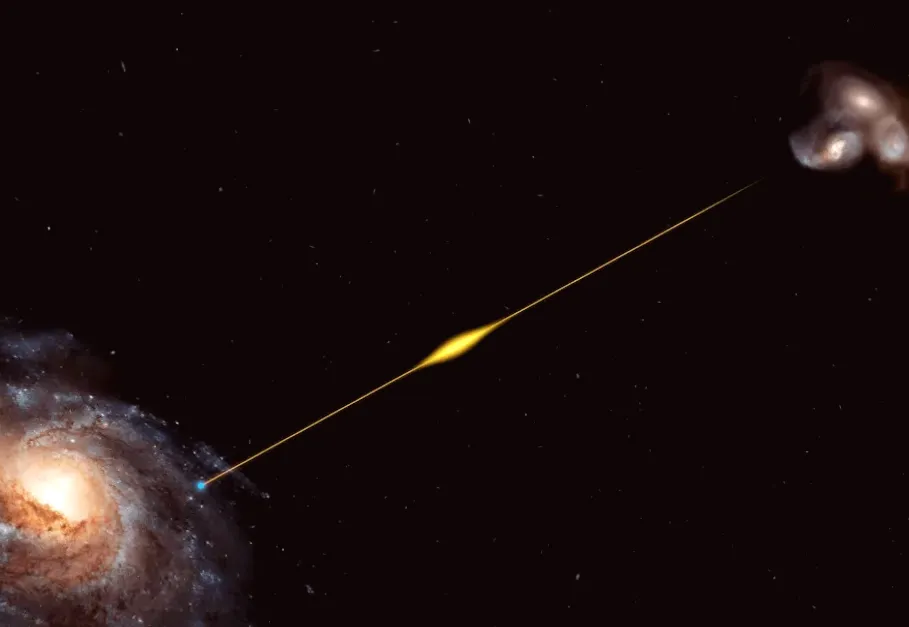
In recent years, astronomers have gained a new tool to address the mystery of the missing matter: fast radio bursts (FRBs). These intense bursts of radio waves release more energy in a millisecond than the Sun emits over three days. Discovered in 2007, FRBs are thought to originate from compact stellar remnants in distant galaxies. As the bursts travel through space, their energy diminishes, and by the time they reach Earth, they are a thousand times weaker than a mobile phone signal detected from the Moon.
Research from early 2025 suggests that FRBs are emitted by a particular type of neutron star known as a magnetar. Magnetars are neutron stars with magnetic fields that are about a thousand trillion times stronger than Earths. Although the exact origin of FRBs remains unclear, astronomers can use these bursts to probe the space between galaxies. As the bursts pass through hot intergalactic gas, interactions with electrons in the medium cause longer wavelengths to slow down, spreading the radio signal in a way similar to how a prism separates light. By measuring this spreading, scientists can estimate how much gas the burst has passed through on its way to Earth.
New Discoveries from the Latest Study
In a June 2025 study, astronomers from Caltech and the Harvard Center for Astrophysics analyzed 69 fast radio bursts using an array of 110 radio telescopes in California. Their findings revealed that 76% of the universes normal matter resides in the vast space between galaxies. An additional 15% is located in the halos surrounding galaxies, while only 9% is found in stars and cold gas within galaxies. This comprehensive account of normal matter strongly supports the Big Bang theory, as it recovers the predicted 5% of normal matter created in the first moments of the universes formation, affirming a key aspect of the theory.
With thousands of fast radio bursts already observed, and an upcoming array of telescopes expected to detect as many as 10,000 per year, this method could soon become a crucial tool for cosmology. By studying these bursts, astronomers may not only map the distribution of atoms across the universe, but also create a three-dimensional map of the cosmic web.
The Larger Mystery Remains
While astronomers may have solved one piece of the cosmic puzzle, most of the universe is still composed of substances that remain largely mysterious. Dark matter, which makes up around 27% of the universe, and dark energy, the force accelerating the universes expansion, remain poorly understood. Dark matter is believed to be a type of particle that doesnt fit into the standard model of particle physics, and although it has not yet been directly detected, its presence is inferred from the way it bends light through gravitational lensing, showing that it outweighs visible matter by a factor of more than five.
While dark matter still eludes our full understanding, the study of normal matter continues to provide valuable insights into the universe and its evolution.
Author: Gavin Porter
Share

The final full moon of 2025 will shine tonight, marking one of the last supermoons for some time.
40 minutes ago 2 min read WORLD

Michael Bublé considers meeting Pope Leo as 'one of the greatest moments'
48 minutes ago 2 min read WORLD

Prince George is receiving instruction on his future duties as king — Source
49 minutes ago 3 min read WORLD

Video of Nigerian customs officer justifying feeding bandits is outdated
55 minutes ago 3 min read WORLD

Have We Finally Moved Beyond the "Jaws Effect?"
1 hours ago 2 min read WORLD

The Royal Family's Best Photos from the German State Banquet at Windsor Castle
1 hours ago 2 min read WORLD

Tragic Accident: 6-Year-Old Boy Fatally Struck by School Bus During Drop Off, Leaving Community Devastated
1 hours ago 2 min read WORLD

Prince George remains unfazed by his future responsibilities as a future king — Source
1 hours ago 2 min read WORLD

Flavio Bolsonaro announces candidacy for Brazil’s 2026 presidential election endorsed by his father
1 hours ago 4 min read WORLD

Leader of Lithuanian governing party convicted for inciting hatred against Jews
1 hours ago 2 min read WORLD